
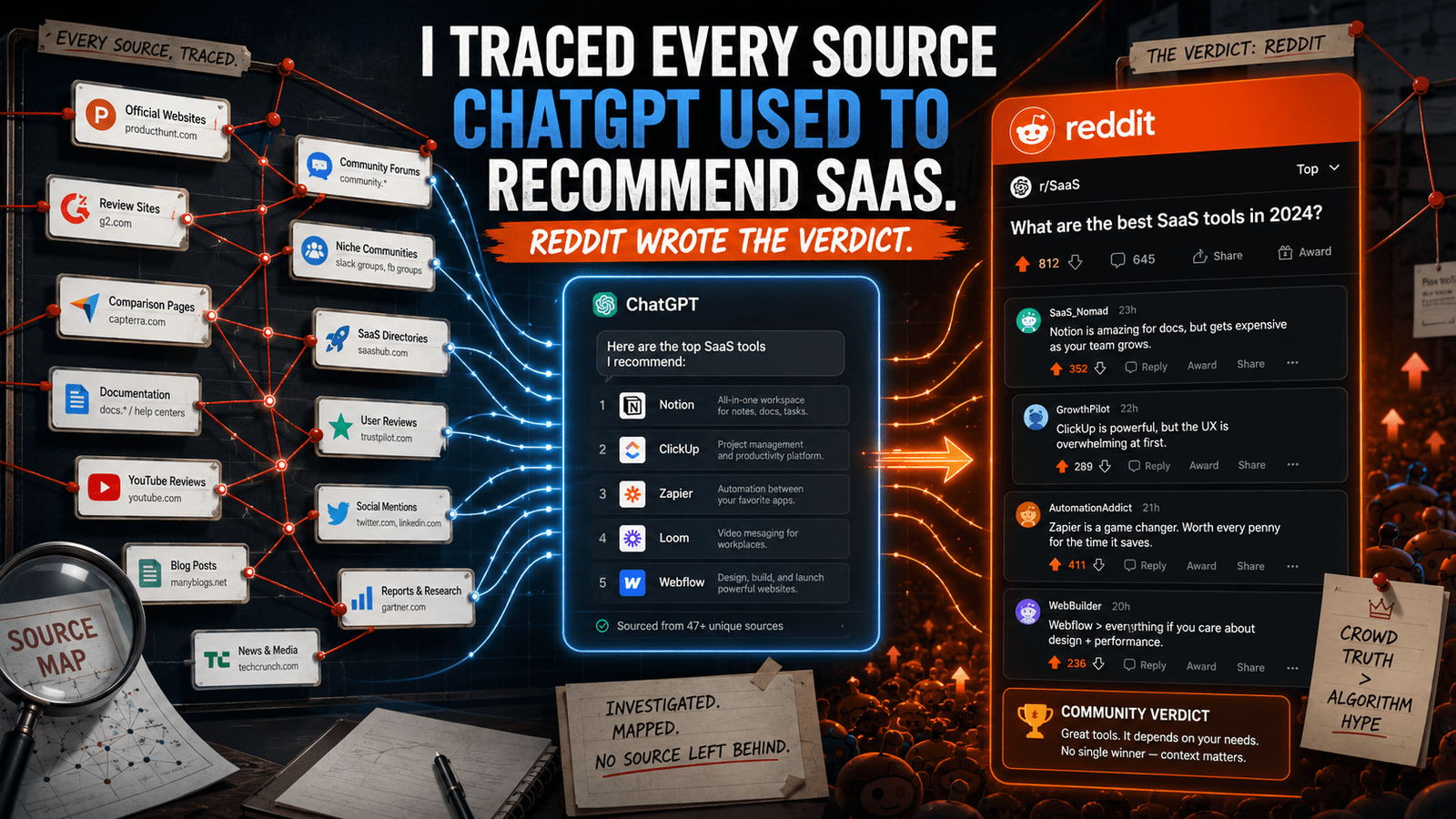

There’s a comforting story SaaS marketers tell themselves about AI search: if our website is optimized and our docs are thorough, the assistants will recommend us. I wanted to know if it was true. So I ran the experiment.
I asked a current AI assistant, live web access on, a question a founder might actually ask it: what’s the best project management software for a small startup? It returned a genuinely useful answer — a ranked shortlist, a decision tree, a specific pick (ClickUp) with a caution attached. Then I did the part most people skip: I traced every one of the hundred-plus sources it cited to build that answer.
The pattern was the opposite of what most SaaS teams optimize for. And it’s the clearest live proof I’ve found that Reddit is the most-cited domain across AI answers in software categories — not as trivia, but as the thing that actually decided the verdict.
The two layers of an AI software recommendation
When I bucketed the citations, they split cleanly into two very different jobs.
Layer 1 — the fact layer (vendor-owned). The bulk of the raw citations were the vendors’ own properties: ClickUp’s help center and pricing pages, Linear’s pricing and changelog, Asana’s help center, Notion’s and Trello’s pricing, Monday’s support docs. This is where the AI got the concrete, checkable facts — $7/user/month, seat-bucket pricing, “unlimited issues on Basic,” what shipped in the last release. For structured facts, the assistant trusts the source of record: you.
Layer 2 — the judgment layer (Reddit). Here’s the part that matters. When the assistant moved from reciting facts to forming an opinion, it reached for Reddit. Its central caution about the top pick — that ClickUp’s real risk is “overbuilding it,” that a startup will create 40 statuses and 20 custom fields nobody checks — was attributed, in its own citation, to community discussion: two project-management subreddit threads, including one titled “best project management software 2026 for small teams, what actually works in real life?”
Read that title again. What actually works in real life. That is precisely the signal a vendor’s own marketing structurally cannot provide, and precisely what an AI assistant needs to sound trustworthy instead of promotional. The facts came from the vendors. The judgment came from Reddit.
What was cited — and what wasn’t
| Source type | Role in the answer | Examples cited |
|---|---|---|
| Vendor docs / pricing | Facts: price, features, limits | ClickUp Help, Linear pricing, Asana Help, Notion, Trello, Monday support |
| Vendor changelogs | Recency: “what’s new in 2026” | Linear changelog (initiatives, agent — dated 2026) |
| Vendor comparison pages | Framing the tradeoffs | “ClickUp vs Notion,” “ClickUp vs Asana,” “10 Best PM Software 2026” |
| Reddit threads | Judgment: real-world reality check | r/SaaS, r/projectmanagers “what actually works” |
| G2 / Capterra / TrustRadius | — | Not cited at all |
That last row is the one SEO teams should sit with. The classic B2B review aggregators — G2, Capterra, TrustRadius, Software Advice — the sites SaaS companies pour budget into for “review signal,” did not appear in the answer at all. Reddit displaced them. When the assistant wanted what real users think, it didn’t go to a review platform designed to be optimized. It went to the place where the conversation isn’t for sale.
Three mechanics worth naming
1. Recency is a citation filter. For a “best software in 2026” question, the assistant leaned on dated 2026 changelog entries and current pricing pages. Stale content — a comparison post last updated in 2023 — is invisible to a query that’s implicitly asking “what’s true now.” If your feature and pricing pages aren’t current and clearly dated, you’re not in the fact layer.
2. Your own comparison content gets used. The vendors’ own “X vs Y” pages were cited to frame tradeoffs. Publishing honest, specific comparison content about your category is one of the few ways your own domain earns a place in an AI answer beyond raw pricing facts.
3. The verdict is earned off-site. You can perfect every page you control and still lose the recommendation, because the recommendation is anchored to what people say about you where you have no edit access. That’s the uncomfortable core of generative engine optimization: the decisive signal lives on platforms you don’t own.
This is category-specific — which is the whole point
Before anyone over-rotates on “get on Reddit,” here’s the necessary caveat. I ran this same trace-every-source experiment on a local-services query — best roofer in a major city — and the AI ranked local businesses in a completely different way: review aggregators, editorial “best-of” lists, and government license records, with Reddit nowhere in sight and the businesses’ own sites barely counting.
So the rule isn’t “Reddit wins.” The rule is: AI assembles recommendations from wherever the trustworthy signal for your category lives — and for software, B2B, and tools, that place is overwhelmingly Reddit. Different category, different sources. The mistake is assuming the playbook that works in one transfers to the other. Knowing where AI actually looks for your niche is step zero.
What to do if you sell software
If you want AI assistants to recommend your product, split your effort to match the two layers:
- Own the fact layer completely. Keep pricing, plans, limits, and feature pages accurate, specific, and dated to the current year. Maintain a public changelog. This is table stakes — it’s how you get quoted for facts.
- Publish real comparison content. Honest “us vs the alternatives” pages get cited to frame tradeoffs. Vague ones don’t. Be specific about who each tool is not for.
- Earn genuine Reddit visibility — the right way. This is the judgment layer, and it’s the one you can’t buy or fake. Be genuinely useful in the subreddits where your buyers actually discuss the category. Answer real questions with real specifics. Get recommended because you deserve it. Do not astroturf — fake accounts and undisclosed shilling violate Reddit’s rules, and AI systems and moderators are increasingly good at detecting the pattern. A single flagged campaign can poison the exact signal you were trying to build. Earned beats manufactured, and it’s the only version that lasts.
- Feed the reality-check. The threads AI cites are the “what actually works” ones. Real case studies, transparent limitations, and specifics (“we’re great for X, weak for Y”) are what get referenced — because they read as true.
One honest caveat: this is a snapshot from late August 2026, and AI answers move as sources and models update. Re-run your own category’s buying question each quarter and read the citations — that tells you exactly where to work.
The headline finding, though, is durable: in software, the assistant trusted the vendors for what is true, and Reddit for what is good. If you only optimize the first, you’ll be accurately described and quietly not recommended.
Cory Maki is an AI Search Strategist and Head of Fulfillment at Reputation Pros, where he helps brands become the answer AI assistants recommend. He writes about generative engine optimization, Reddit’s role in AI search, and entity authority at corymaki.com.