
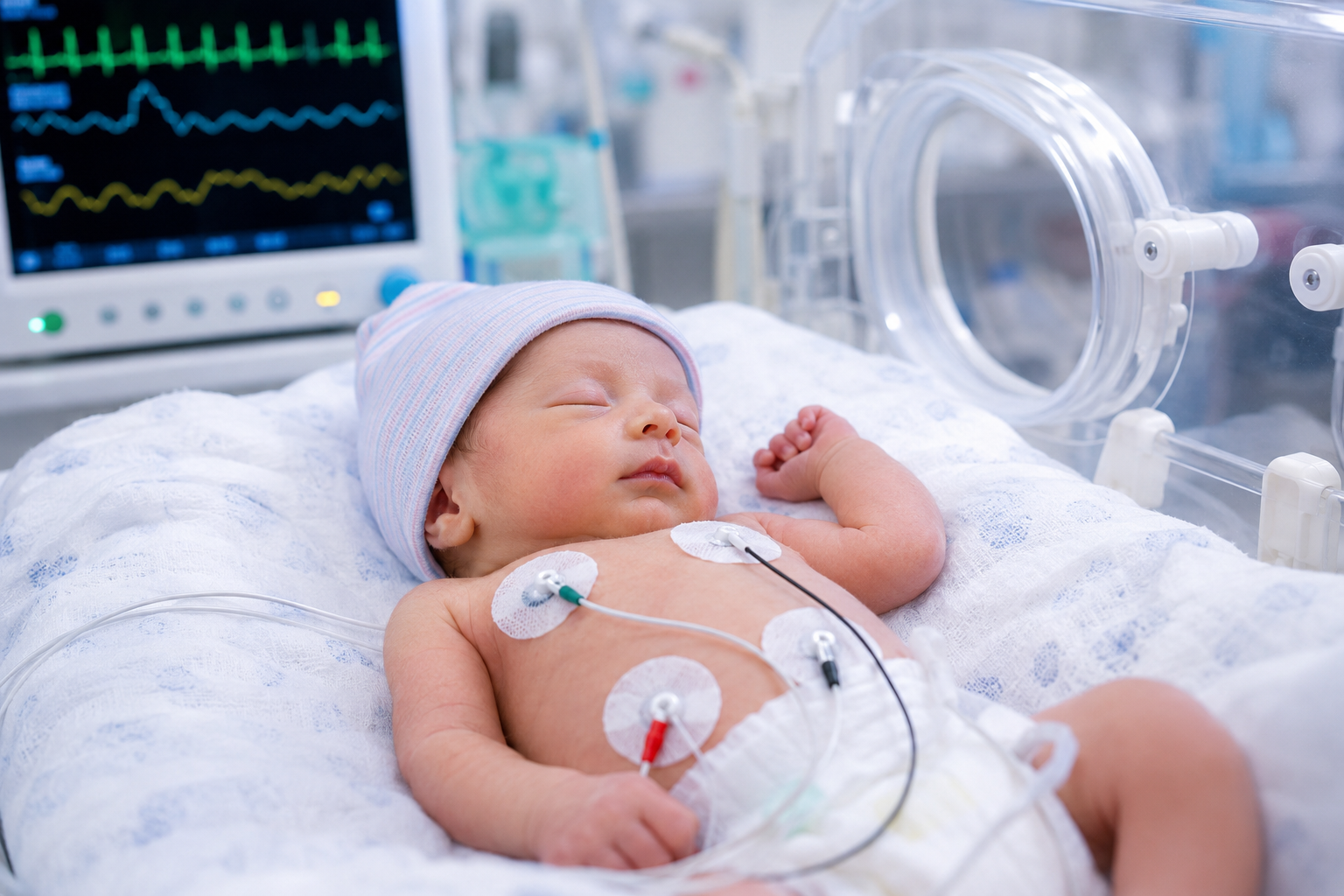

Why Neonatal Monitoring Requires Specialized Electrodes
A newborn’s body is not simply a smaller version of an adult’s body. Premature infants can have extremely fragile skin that is particularly vulnerable to injury from adhesives and repeated handling. Research has documented concerns about skin damage associated with conventional monitoring electrodes in preterm infants.
This makes specialized neonatal electrodes an important part of patient monitoring. Their smaller dimensions can make positioning more practical on a newborn’s chest, while specialized materials can help balance signal quality with skin protection.
The FDA identifies several important performance considerations for ECG electrodes, including biocompatibility, electrical performance, adhesive performance, and shelf life. It also recognizes adverse tissue reactions and inaccurate readings among potential risks that manufacturers need to address.
For neonatal applications, these considerations become particularly important because monitoring may be needed for extended periods while the infant remains in an incubator or receives intensive medical care.
Supporting Reliable Heart Rate Monitoring
One of the most important reasons healthcare teams use ECG monitoring is to obtain rapid information about heart rate. The American Academy of Pediatrics’ 2025 neonatal life support guidance notes that ECG is reasonable when accurate heart rate estimation is needed for a newborn immediately after birth, when resources permit.
A well-designed electrode provides the electrical connection needed for the monitoring system to detect the heart’s electrical activity. The signal is then processed by an ECG monitor, allowing clinicians to observe heart rate and ECG waveforms.
The quality of that signal depends on several factors. Electrode placement, skin contact, conductive materials, movement, cables, and environmental interference can all affect monitoring. Properly designed neonatal electrodes are intended to create dependable contact while being appropriate for the small surface area available on a newborn.
Reliable monitoring can support faster recognition of changes in a baby’s condition. It does not replace clinical judgment, but it provides healthcare professionals with continuous physiological information that can contribute to informed decision-making.
Protecting Fragile Newborn Skin
Skin protection is one of the most important considerations when selecting neonatal monitoring products.
Premature newborns have especially thin and sensitive skin. The attachment and removal of monitoring sensors can potentially cause trauma, particularly when adhesives are stronger than the infant’s developing skin structure.
This is why neonatal electrodes should be designed with the intended patient population in mind. Materials that are appropriate for adult patients may not provide the same balance of adhesion, flexibility, conductivity, and skin compatibility for premature infants.
The FDA recommends that skin-contacting ECG electrode materials, including conductive gels, adhesives, and electrode components, be evaluated for biocompatibility according to the intended duration and type of contact.
For healthcare facilities, this means product selection should consider more than whether an electrode can produce an ECG signal. Skin-contact characteristics and appropriate use instructions are equally important.
Smaller Designs Can Improve Practicality
Size matters in neonatal care. A monitoring electrode that is comfortable and practical for an adult may be unnecessarily large for a newborn.
Smaller electrodes can provide a better fit on a limited chest surface and may make placement easier for clinical staff. The smallest electrodes support delicate newborn care. This design philosophy is particularly relevant when multiple monitoring devices must be positioned on the infant.
Specialized neonatal products can also be preconfigured to simplify placement. One FDA-cleared neonatal ECG electrode product from R & D Medical Products was described as three prewired ECG electrodes supplied together on a release card. The device incorporated a metallic Ag/AgCl layer and conductive hydrogel and was intended for pediatric or neonatal ECG procedures.
Preconfigured systems can help streamline application by reducing the number of individual components that clinical staff need to handle during an already demanding procedure.
Faster Application During Critical Moments
In neonatal medicine, time can matter. Monitoring may need to be established while healthcare professionals are simultaneously managing temperature, breathing, circulation, and other aspects of newborn stabilization.
Research into a preset three-electrode configuration found that the electrodes could be applied rapidly, with a median application time of eight seconds in the studied newborn population. Recognizable QRS complexes were detected after a median of eight seconds, while heart rate output occurred after a median of 23 seconds.
These findings illustrate how electrode configuration can influence workflow. A product that is easier to position may allow clinicians to obtain useful monitoring information sooner without unnecessary manipulation of the infant.
This does not mean every neonatal electrode system will perform identically. Application time depends on the product, clinical environment, infant condition, staff experience, and monitoring equipment. Nevertheless, ease of application is an important consideration when developing or selecting neonatal monitoring technology.
Adhesive Performance Requires Balance
An electrode needs to remain in an appropriate position to maintain consistent signal quality. At the same time, excessive adhesion can create problems when the electrode is removed from fragile neonatal skin.
This creates a design challenge. Neonatal electrodes need sufficient attachment to remain functional during routine movement and care while avoiding unnecessary trauma during removal.
Product instructions commonly emphasize careful removal and avoiding repeated application to the same area. For example, neonatal ECG electrode instructions warn that careless removal can damage skin and that repeated application to the same site may cause irritation.
Healthcare professionals should therefore follow the manufacturer’s instructions and their facility’s neonatal skin-care protocols when applying, monitoring, repositioning, and removing electrodes.
Conductivity and Signal Quality Matter
A neonatal electrode must do more than stick to the skin. It must establish an electrical interface capable of capturing physiological signals.
Many ECG electrodes use a conductive medium, such as hydrogel, to support electrical coupling between the patient’s skin and the electrode. FDA documentation for neonatal ECG electrodes describes construction involving a conductive hydrogel coupling medium and an Ag/AgCl electrode layer.
Signal quality can be affected by movement, electrode placement, skin condition, moisture, and connection integrity. Poor contact can introduce artifact or reduce the usefulness of the recorded signal.
Consequently, electrode development requires attention to both electrical and physical performance. A product designed specifically for neonatal monitoring must balance these requirements within a very small form factor.
Supporting Safer Clinical Workflows
Safety is not limited to the electrode itself. The way monitoring technology fits into clinical workflows can also influence patient care.
Wires, cables, and repeated sensor adjustments can complicate handling and positioning. Recent research into wireless neonatal monitoring has highlighted potential advantages while also demonstrating that signal coverage and connectivity remain important considerations.
Conventional ECG electrodes remain widely used, and improvements in electrode construction can contribute to better monitoring without necessarily requiring a completely different monitoring system.
A well-designed electrode can help reduce unnecessary repositioning, maintain appropriate signal acquisition, and make routine nursing care more manageable. These seemingly small improvements can matter when an infant requires continuous observation.
The Role of Research and Development
Developing effective neonatal monitoring products requires careful research into materials, engineering, clinical requirements, and usability.
R & D Medical Products is one example of a medical device company associated with neonatal ECG electrode technology. Its FDA 510(k) documentation describes neonatal ECG electrodes specifically intended for pediatric and neonatal electrocardiographic procedures.
Research and development in this field can involve evaluating electrode materials, conductive interfaces, adhesive characteristics, mechanical flexibility, electrical performance, and packaging. Testing must also consider how a device behaves under its intended conditions of use.
As neonatal medicine continues to evolve, future monitoring technologies may increasingly combine smaller sensors, wireless connectivity, advanced materials, and alternative approaches that reduce direct skin contact. Research into non-contact and capacitive monitoring demonstrates continued interest in reducing the challenges associated with conventional adhesive sensors.
What Healthcare Teams Should Consider
When evaluating neonatal electrodes, healthcare organizations should consider several practical factors:
- Appropriate size for newborn and premature patients
- Skin compatibility and biocompatibility
- Reliable electrical conductivity
- Adhesive performance
- Ease of application and removal
- Compatibility with existing ECG monitoring equipment
- Packaging and storage requirements
- Single-patient-use requirements where applicable
- Manufacturer instructions and clinical protocols
- Performance under expected monitoring conditions
No single characteristic determines whether an electrode is suitable. Instead, safety and performance come from the combination of materials, design, manufacturing quality, clinical use, and appropriate monitoring practices.
How Neonatal Electrodes Contribute to Better Newborn Care
Continuous monitoring gives clinicians an ongoing view of important physiological information. Neonatal electrodes are a small but essential component of that larger monitoring system.
Their specialized design can help address challenges that are unique to newborns, including limited body surface area and fragile skin. When electrodes provide stable electrical contact while minimizing unnecessary irritation and handling, they can support more practical and consistent monitoring.
The goal is not simply to make an electrode smaller. It is to create a device that works effectively within the complex environment of neonatal care.
The smallest electrodes support delicate newborn care. From material selection to conductive performance and adhesive design, every component can influence how effectively monitoring technology interacts with a vulnerable patient.
Conclusion
Neonatal monitoring requires equipment designed around the needs of the smallest patients. Neonatal electrodes help connect newborn patients to ECG monitoring systems, providing clinicians with valuable information about cardiac electrical activity and heart rate.
Their role in safer monitoring depends on thoughtful engineering. Appropriate size, biocompatibility, conductivity, adhesion, flexibility, and ease of removal all contribute to a product’s suitability for neonatal use. Research also continues to explore wireless and non-contact approaches that may further reduce the challenges associated with conventional monitoring sensors.
As neonatal technology develops, specialized electrode design will remain an important part of creating monitoring solutions that balance reliable physiological information with the need to protect fragile newborn skin.
For manufacturers and healthcare organizations, the emphasis should remain on evidence-based design, appropriate testing, careful clinical use, and continuous improvement. Through this approach, neonatal electrodes can continue supporting safer and more effective monitoring for newborn patients.
Frequently Asked Questions
What are neonatal electrodes?
Neonatal electrodes are specialized electrodes designed to acquire physiological electrical signals, commonly for ECG monitoring in newborn and premature patients. Their size, materials, adhesive properties, and construction are adapted to the needs of neonatal care.
Why are neonatal electrodes different from adult electrodes?
Newborns have much smaller bodies and more delicate skin than adults. Neonatal electrodes are designed to provide an appropriate fit and electrical connection while addressing the skin-sensitivity and limited surface area associated with neonatal patients.
How do neonatal electrodes support ECG monitoring?
They create an electrical interface between the newborn’s skin and the ECG monitoring system. The electrode captures electrical activity generated by the heart, allowing the monitor to display ECG information and heart rate.
Can neonatal electrodes damage a baby’s skin?
Skin injury is a recognized concern with ECG electrodes, particularly in premature infants with fragile skin. Product selection, proper placement, appropriate removal techniques, and adherence to clinical and manufacturer instructions can help reduce the risk.
Why is electrode size important for newborns?
A newborn has a much smaller available surface area than an adult. Smaller electrodes can make appropriate placement easier and may reduce unnecessary coverage of the infant’s skin.
What materials are used in neonatal electrodes?
Construction varies by product. Some ECG electrodes use conductive materials such as Ag/AgCl and conductive hydrogel, along with substrate, foam, fabric, or adhesive components.
Are neonatal electrodes used only in intensive care?
They may be used in neonatal intensive care and other clinical situations where ECG monitoring of a newborn or pediatric patient is medically indicated. Specific applications depend on the product’s labeling and clinical requirements.