
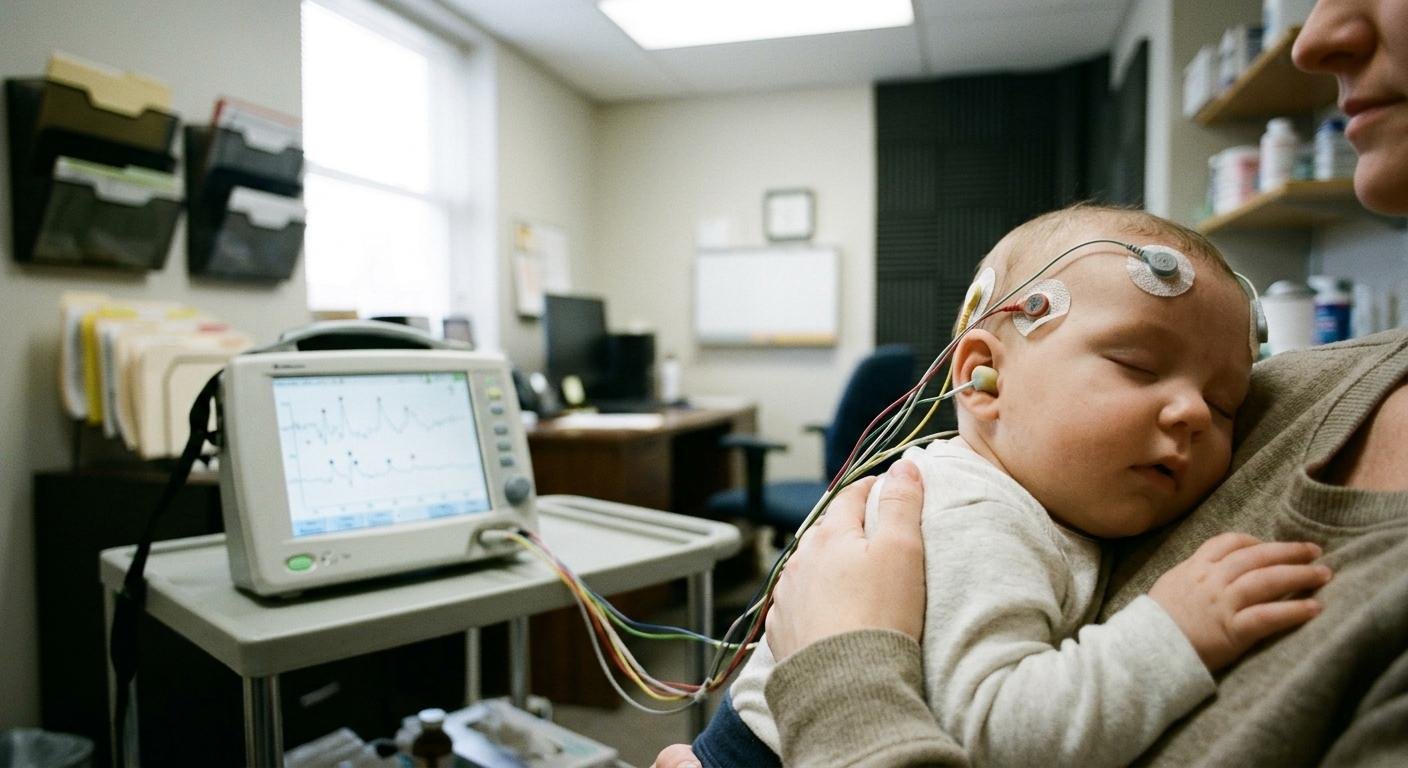

What Is an ABR Hearing Test?
An ABR hearing test records the brain’s electrical response to sound. During the procedure, small electrodes are placed on the scalp and near the ears to detect neural activity generated when sound travels through the auditory system.
The test typically uses clicks or tone bursts delivered through earphones or insert earphones. Each sound stimulates the auditory pathway, producing a series of electrical responses that the testing equipment records and averages over multiple presentations.
These responses appear as waveforms on a computer display. Audiologists examine the waveforms to evaluate response timing, amplitude, reproducibility, and other characteristics that help determine whether auditory signals are traveling through the expected pathways.
The ABR hearing test is especially important when conventional behavioral hearing assessments are impractical. For example, newborns cannot describe what they hear, and some patients may have developmental, neurological, or communication challenges that make standard testing difficult.
What Does an ABR Test Measure?
An ABR test primarily evaluates the timing and strength of electrical responses associated with the auditory nerve and brainstem. Clinicians commonly assess several features.
- Waveform latency: This describes the time between a sound stimulus and the appearance of a particular electrical response.
- Waveform amplitude: This measures the size of the recorded electrical response.
- Response reproducibility: Consistent waveforms across repeated recordings increase confidence that the response is genuine.
- Hearing sensitivity estimates: When frequency-specific stimuli are used, ABR results can help estimate hearing thresholds at different frequencies.
- Neural transmission: Certain response patterns can provide information about how sound signals travel through the auditory nerve and brainstem.
The ABR hearing test does not directly measure a patient’s subjective experience of sound. Instead, it provides objective information about auditory pathway activity. Results must be interpreted alongside the patient’s history, other hearing assessments, and the clinical question being investigated.
Why Electrodes Are Essential to ABR Testing
Electrodes are a critical part of the recording system because they detect the small voltage changes associated with auditory neural activity. These signals can be difficult to distinguish from electrical interference, muscle activity, and other sources of background noise.
A properly designed electrode system helps capture the desired response while reducing unwanted interference. If an electrode has poor contact with the skin, moves during testing, or develops inconsistent electrical contact, the recorded signal may become noisy or unstable.
In an ABR hearing test, the quality of the electrode system can affect how easily an audiologist identifies important waveform peaks. Poor recordings may require additional averaging, repeated electrode preparation, or repositioning before a reliable interpretation is possible.
Electrode quality therefore involves several characteristics, including conductive performance, flexibility, adhesive consistency, skin compatibility, and the ability to maintain stable contact throughout the procedure.
Understanding the ABR Electrode Montage
An electrode montage refers to the arrangement of recording and reference electrodes used to capture electrical activity. The montage determines how voltage differences are measured and influences the appearance of the resulting waveforms.
A typical clinical ABR setup may include an active electrode positioned at the forehead or scalp vertex, reference electrodes near the mastoid regions or earlobes, and a ground electrode at another suitable location. Exact placements vary according to the testing protocol, equipment, patient population, and clinical purpose.
Active, Reference, and Ground Electrodes
Each electrode has a specific role in the recording system.
Active electrode: This electrode detects electrical activity from a designated scalp location. Its position influences the amplitude and polarity of the recorded response.
Reference electrode: The reference provides the comparison voltage used to calculate the recorded signal. Its location affects the measured waveform because the recording represents a voltage difference rather than an isolated electrical measurement.
Ground electrode: The ground helps manage common electrical interference and supports stable operation of the recording system. It is not interchangeable with the active or reference electrodes.
Correct electrode placement is essential because the electrical response detected by one montage may differ from the response obtained using another. Consistent placement helps clinicians compare recordings and interpret changes in waveform morphology or latency.
Why Montage Consistency Matters
A consistent montage supports reproducibility across test sessions. If electrode positions change substantially between recordings, differences in waveform amplitude or appearance may reflect the setup rather than a meaningful change in auditory function.
This is especially relevant when monitoring hearing over time, assessing infants, or comparing results obtained under different clinical conditions.
Electrodes must also remain secure while the patient rests. Small movements can alter skin contact and introduce artifacts that make waveform interpretation more difficult.
How Impedance Influences ABR Waveform Clarity
Electrode impedance describes the opposition to electrical current at the electrode-skin interface. In practical terms, it helps indicate how effectively an electrode is electrically coupled to the skin.
High or uneven impedance can contribute to increased noise and reduced recording stability. Differences between electrode impedances may also make the recording more vulnerable to interference, depending on the equipment and testing environment.
During an ABR hearing test, clinicians typically prepare the skin and check electrode impedance before beginning the recording. Appropriate preparation may include cleaning the skin, gently removing excess surface oils, and following the electrode manufacturer’s instructions.
Why Low and Balanced Impedance Matters
Low, reasonably balanced impedance across the recording electrodes generally supports reliable signal acquisition. However, the exact acceptable range depends on the equipment, electrode type, and clinical protocol. Clinicians should follow the system’s specified limits rather than relying on one universal target.
Stable impedance can help reduce unwanted noise and improve the reproducibility of recorded waveforms. This is important because ABR responses are small and may be obscured when background electrical activity is excessive.
Impedance should also be monitored when recordings appear unstable. If the readings change unexpectedly, an electrode may have loosened, the skin contact may have deteriorated, or movement may have affected the connection.
Common Causes of Impedance Problems
Several factors can interfere with stable electrode contact:
- Inadequate skin preparation.
- Excessive oil, sweat, or moisture on the skin.
- Dried or improperly applied conductive gel.
- Poor electrode positioning or uneven pressure.
- Loose connectors or damaged electrode leads.
- Movement that disrupts the electrode-skin interface.
Addressing these problems before and during testing can reduce avoidable recording interruptions and improve the quality of the collected data.
The Role of Adhesion Quality in Reliable ABR Results
Adhesion quality determines how well an electrode remains attached to the skin throughout testing. Even an electrode with good conductive properties may produce inconsistent recordings if it shifts, lifts at the edges, or loses contact during the procedure.
Reliable adhesion is particularly important when testing newborns and young children. These patients may move during sleep or reposition their heads, potentially disturbing the electrodes and affecting signal stability.
A secure electrode helps maintain consistent contact without requiring repeated adjustments. However, stronger adhesion is not automatically better. Electrodes must also be suitable for the patient’s skin and intended duration of use.
Balancing Adhesion and Skin Compatibility
Electrodes used in clinical hearing assessments should provide dependable contact while minimizing the risk of irritation or skin damage. This balance is particularly important for neonatal applications, where skin can be more delicate than adult skin.
Relevant design considerations include the adhesive formulation, backing material, flexibility, electrode size, and ease of removal. A backing that conforms to the skin may help reduce lifting around the edges, while an appropriate adhesive can support contact without excessive pressure.
Manufacturers and healthcare facilities should consider whether electrodes are suitable for the intended patient population, compatible with the recording equipment, and appropriate for the expected testing duration.
How Poor Adhesion Can Affect Recordings
Poor adhesion may cause several practical problems during an ABR hearing test:
- Intermittent contact can produce fluctuating impedance.
- Electrode movement can introduce artifacts.
- Repeated adjustments can lengthen testing sessions.
- Unstable recordings may require additional signal averaging.
- Skin irritation or difficult removal can affect patient comfort and workflow.
When waveforms are unclear, clinicians should evaluate electrode contact alongside other potential causes, including environmental electrical interference, muscle activity, stimulus delivery, and patient movement. Not every recording problem originates with the electrode itself.
Choosing Suitable Electrodes for ABR Applications
Electrode selection should consider the clinical environment, patient age, recording equipment, and expected testing conditions. No single electrode design is ideal for every application.
Important considerations include:
Conductive performance: The electrode should support stable electrical contact and reliable detection of low-amplitude signals.
Adhesive consistency: Adhesion should remain dependable throughout the test while allowing appropriate removal.
Material flexibility: Flexible backing materials may help electrodes conform to curved scalp and skin surfaces.
Skin compatibility: Materials should be suitable for the intended population and tested for their intended use.
Connection reliability: Connectors and leads should maintain secure electrical connections and withstand routine clinical handling.
Product consistency: Consistent manufacturing quality can help reduce variation between electrodes and support repeatable testing procedures.
For organizations involved in medical electrode development, these requirements highlight why material selection and manufacturing controls are important. Variations in conductive components, adhesive application, or backing construction can affect how an electrode performs in actual clinical use.
How Clinicians Improve ABR Recording Quality
Reliable results depend on a combination of sound clinical technique, suitable equipment, and careful signal-quality checks. Electrode selection alone cannot compensate for poor testing conditions.
Before starting, clinicians should verify the equipment setup, prepare the skin appropriately, position electrodes according to the selected montage, and check impedance. They should also ensure that insert earphones or other stimulus-delivery components are positioned correctly.
During recording, the patient should be as relaxed and still as practical. Infants are often tested while naturally asleep, following the clinical team’s procedures. Reducing movement and muscle activity can improve the signal-to-noise ratio.
Repeated waveform recordings help confirm whether observed responses are reproducible. If the response is unclear, the clinician may investigate electrode contact, environmental noise, stimulus delivery, and other technical factors before deciding whether additional testing is needed.
Finally, an ABR hearing test must be interpreted by a qualified professional. An unclear waveform should not automatically be treated as evidence of hearing loss, and a technically adequate recording must still be evaluated in the context of the patient’s clinical needs.
Conclusion
An ABR hearing test provides objective information about how the auditory nerve and brainstem respond to sound. Its usefulness depends on obtaining clear, reproducible electrical recordings that clinicians can interpret with confidence.
Electrode montage determines how auditory responses are captured, while impedance and adhesion quality influence electrical stability and resistance to movement-related artifacts. Appropriate electrode selection, careful skin preparation, secure placement, and consistent testing procedures all contribute to dependable results.
For clinical teams and medical device developers, understanding these factors supports better recording practices, more consistent electrode performance, and improved testing workflows. By paying attention to both the clinical protocol and the electrode-skin interface, healthcare professionals can make the most of the information an ABR assessment provides.
Frequently Asked Questions
1. What is an ABR hearing test used for?
An ABR hearing test evaluates electrical responses generated by the auditory nerve and brainstem after sound stimulation. It is commonly used to assess hearing in newborns, infants, and patients who cannot reliably complete conventional behavioral hearing tests.
2. Does an ABR test measure hearing loss directly?
The test measures neural responses to sound rather than a person’s subjective perception. Depending on the protocol, results can help estimate hearing thresholds and identify patterns that require further audiological evaluation.
3. Why are electrodes needed during an ABR hearing test?
Electrodes detect small electrical voltage changes associated with auditory activity. Their placement and electrical contact influence the quality of the recorded waveforms and how confidently clinicians can identify responses.
4. How does electrode impedance affect ABR results?
High or uneven impedance can contribute to electrical noise and unstable recordings. Appropriate skin preparation, secure placement, and impedance checks help clinicians obtain clearer and more reproducible waveforms.
5. Can poor electrode adhesion affect a hearing test?
Yes. Electrodes that shift or lift from the skin can produce fluctuating contact and recording artifacts. Secure, skin-compatible adhesion helps maintain consistent contact throughout the assessment.
6. Where are electrodes placed during an ABR test?
A typical setup uses an active electrode on the forehead or scalp vertex, reference electrodes near the mastoid regions or earlobes, and a ground electrode at another designated location. The exact arrangement depends on the clinical protocol and equipment.
7. What should clinicians do if ABR waveforms are unclear?
They should assess electrode contact and impedance, verify stimulus delivery, reduce movement and environmental interference, and repeat recordings when appropriate. Unclear results should be interpreted cautiously by a qualified audiologist.
8. What features matter when selecting electrodes for ABR testing?
Important features include stable conductivity, reliable adhesion, flexibility, skin compatibility, secure connections, and consistent manufacturing quality. Selection should reflect the patient’s needs and the intended clinical application.