
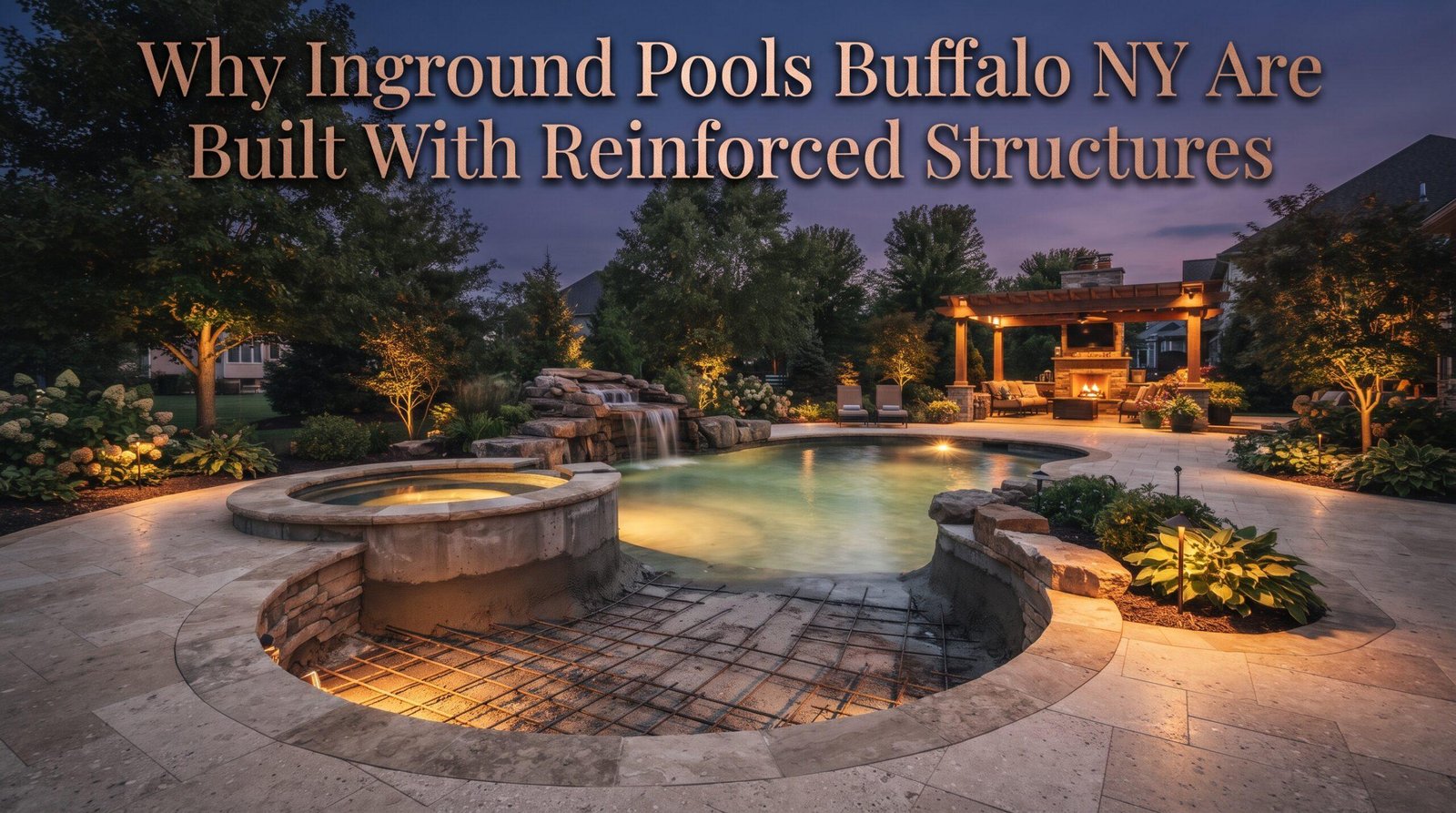

An inground swimming pool is a major addition to any property, but its long-term performance depends on much more than its appearance or water capacity. Beneath the finished surface, a pool needs a carefully engineered structure capable of holding thousands of gallons of water while resisting pressure from the surrounding soil, groundwater, and changing weather conditions.
In Buffalo, New York, these structural requirements are especially important. The region experiences freezing winters, seasonal temperature fluctuations, periods of heavy precipitation, and soil conditions that can place considerable stress on underground construction. A pool that is not properly designed and reinforced may become vulnerable to cracking, shifting, leaks, and other expensive problems.
Reinforced construction helps address these challenges by creating a stronger structural system. Depending on the pool design, reinforcement may involve steel bars, concrete, specialized wall systems, or combinations of materials intended to distribute loads and maintain structural stability.
Understanding why reinforcement matters can help homeowners make better decisions when planning a swimming pool. It also explains why professional engineering, soil evaluation, and proper construction techniques are essential parts of a successful project.
Why Inground Pools Need Structural Reinforcement
An inground pool must withstand forces from both inside and outside the structure. Water creates continuous pressure against the pool walls and floor, while surrounding soil applies pressure from the opposite direction.
These forces change depending on whether the pool is full, partially drained, or empty. Groundwater conditions and seasonal soil movement can create additional challenges.
Reinforcement helps the pool maintain its shape and resist these stresses over time.
Managing the Weight and Pressure of Water
Water is considerably heavier than many homeowners realize. A residential pool can contain tens of thousands of gallons, creating substantial pressure against its walls and floor.
The deeper the pool, the greater the water pressure near the bottom. This means that structural components must be designed to accommodate different pressure levels throughout the pool.
Reinforced concrete and other engineered systems help distribute these forces across the structure rather than concentrating stress in isolated areas.
Without adequate structural support, walls may bow, floors may develop cracks, and joints may become vulnerable to movement.
Resisting Pressure From Surrounding Soil
The soil surrounding an inground pool also exerts pressure against its walls. This pressure can vary depending on soil composition, moisture levels, drainage conditions, and the depth of the excavation.
Clay-heavy soils, for example, may expand when they absorb water and shrink as they dry. These changes can place additional stress on underground structures.
A properly reinforced pool is designed to resist these external forces while maintaining its intended shape.
Maintaining Structural Stability Over Time
A swimming pool is expected to remain in service for many years. During that time, it experiences repeated changes in temperature, water levels, and environmental conditions.
Reinforcement provides additional structural capacity that helps the pool withstand these recurring stresses.
It does not eliminate every possibility of cracking or movement, but it reduces the likelihood that normal environmental pressures will compromise the structure when the pool is properly designed and constructed.
How Reinforced Concrete Strengthens Inground Pools
Concrete is widely used in inground pool construction because it can be formed into different shapes and provides substantial compressive strength.
However, concrete has limitations. Although it performs well under compression, it is less effective at resisting tensile forces that attempt to pull it apart.
This is where steel reinforcement becomes important.
The Role of Steel Rebar
Reinforcing bars, commonly called rebar, are placed within concrete to improve its ability to resist tension and bending.
The concrete and steel work together. Concrete carries much of the compressive load, while the steel helps resist tensile stresses.
In pool construction, reinforcement may be incorporated into walls, floors, steps, benches, and other structural features.
The placement, spacing, size, and configuration of the steel depend on engineering requirements and the specific pool design.
Reinforcement in Pool Walls
Pool walls must resist pressure from the water inside and soil outside.
Steel reinforcement helps strengthen these walls and reduce the risk of structural deformation. The design must account for pool depth, wall thickness, soil conditions, and other relevant loads.
Corners and transitions may require particular attention because changes in geometry can create areas where stresses become concentrated.
Reinforcement in the Pool Floor
The pool floor also requires structural consideration. It must support the water above while interacting with the soil beneath it.
Depending on the construction method and site conditions, reinforcement may be included in the floor to help distribute loads and control cracking.
The floor and walls must also work together as an integrated structure. Poorly designed connections can create weak points where movement or cracking may occur.
Why Buffalo’s Climate Makes Reinforcement Especially Important
Buffalo’s climate creates several challenges for underground construction. Freezing temperatures, snow accumulation, changing groundwater levels, and seasonal soil movement can all influence pool performance.
These factors make structural planning particularly important for homeowners considering an inground pool.
Freeze-Thaw Cycles
During winter, moisture in the soil can freeze and expand. When temperatures rise, the frozen ground thaws and the soil may change volume or consistency.
Repeated freeze-thaw cycles can contribute to ground movement around underground structures.
If a pool is not designed to accommodate the forces associated with these conditions, its walls, floor, or surrounding deck may experience additional stress.
Reinforced construction helps improve structural resistance, but it must be combined with appropriate excavation, drainage, backfill, and installation practices.
Seasonal Groundwater Changes
Groundwater levels can fluctuate throughout the year, particularly after heavy rainfall, snowmelt, or prolonged wet weather.
When groundwater accumulates around a pool, it can create hydrostatic pressure against the structure. In some situations, groundwater pressure may also exert an upward force beneath the pool floor.
This becomes particularly important when a pool is drained or has a significantly reduced water level. The water inside normally helps counterbalance some external pressure, so removing it can change the forces acting on the structure.
A properly designed pool must account for local groundwater conditions and include appropriate measures to manage drainage and hydrostatic pressure.
Soil Expansion and Contraction
Different soil types respond differently to moisture changes.
Clay soils can expand when wet and contract during dry periods. Other soils may drain more quickly but still create settlement concerns if they are loose or poorly compacted.
These changes can affect the ground surrounding the pool and create uneven pressure against the walls.
A site evaluation helps determine what type of preparation and structural design may be necessary.
The Importance of Proper Site Preparation
Reinforcement is only one part of a strong inground pool. Even a well-designed concrete structure can experience problems if the ground beneath and around it is not properly prepared.
Site preparation creates the foundation for the entire installation.
Soil Evaluation Before Excavation
Before construction begins, contractors should evaluate the site to understand its soil conditions and potential challenges.
Important considerations may include:
- Soil composition and stability.
- Existing groundwater conditions.
- Drainage patterns.
- Slope and elevation.
- Nearby structures and underground utilities.
- Accessibility for excavation equipment.
The results help determine how the excavation should be performed and whether additional measures are necessary.
Excavation and Ground Preparation
Excavation must follow the dimensions and elevations specified by the pool design.
The bottom of the excavation needs to provide suitable support for the pool structure. Loose or unsuitable material may need to be removed or replaced with appropriate compacted material.
Uneven excavation can create inconsistent support, potentially increasing stress on the finished pool.
Careful preparation helps ensure that the structure rests on a stable base.
Drainage and Backfill
Drainage is particularly important in areas where water can accumulate around the pool.
Depending on site conditions, a project may require drainage systems or other measures to control groundwater and surface runoff.
Backfill material must also be selected and installed appropriately. Improper backfilling can create uneven pressure, poor drainage, or settlement around the pool walls.
These details may not be visible once construction is complete, but they play an important role in long-term performance.
Different Inground Pool Construction Methods
Not every inground pool uses the same structural system. Different construction methods offer different advantages, and the appropriate choice depends on the property, budget, design, and intended use.
Concrete Pools
Concrete pools offer considerable flexibility in shape, depth, and design.
They can be constructed with curves, integrated steps, tanning ledges, benches, and other custom features. Reinforcing steel is incorporated into the structure to help it resist the forces created by water and surrounding soil.
Because concrete pools are built on-site, construction quality depends heavily on engineering, material specifications, reinforcement placement, and workmanship.
They can be an excellent option for homeowners seeking a highly customized pool.
Fiberglass Pools
Fiberglass pools are manufactured as preformed shells and delivered to the installation site.
Their structural behavior differs from that of a traditional reinforced concrete pool. The shell is designed to provide strength and flexibility, while proper excavation, bedding, backfill, and groundwater management are essential to supporting it.
Although the shell itself is manufactured, the installation still requires careful site preparation and adherence to the manufacturer’s specifications.
Vinyl Liner Pools
Vinyl liner pools typically use a supporting wall system made from materials such as steel, polymer, or other engineered components.
The liner provides the waterproof interior surface, while the wall structure supports the pool’s shape and resists surrounding soil pressure.
The strength of the finished pool depends on the supporting system, proper assembly, base preparation, and installation quality.
Homeowners should compare the structural characteristics of each option rather than assuming that all inground pools are reinforced in the same way.
How Reinforced Construction Helps Prevent Common Pool Problems
Structural reinforcement is intended to improve the pool’s ability to withstand pressure and movement. When combined with proper site preparation and construction practices, it can help reduce the risk of several common problems.
Reducing Structural Cracking
Concrete can develop cracks for several reasons, including shrinkage, temperature changes, settlement, and excessive structural stress.
Reinforcing steel helps control crack development by providing tensile resistance and limiting how cracks behave.
It is important to understand that reinforcement does not make concrete completely crack-proof. The goal is to help the structure maintain its integrity and prevent minor cracking from becoming a more serious structural concern.
Limiting Wall Movement
Pool walls are exposed to pressure from water and surrounding soil.
A properly engineered reinforcement system helps the walls resist bending and deformation. This is especially important for deeper pools, where water pressure is greater.
Appropriate wall thickness, reinforcement placement, and construction quality all contribute to performance.
Protecting Against Settlement
Uneven settlement occurs when different portions of the ground beneath or around a structure move by different amounts.
This can create stress within the pool shell and contribute to cracks, alignment problems, or damage to connected features.
Proper soil preparation and foundation support help reduce settlement risks. Reinforcement provides additional structural capacity, although it cannot compensate for fundamentally unsuitable ground conditions.
Supporting Integrated Features
Modern inground pools often include built-in steps, benches, tanning shelves, and other design elements.
These features create changes in the pool’s geometry and may introduce additional structural considerations.
Reinforcement helps connect these elements to the larger pool structure and distribute loads appropriately.
Why Professional Engineering and Installation Matter
A reinforced pool is only as reliable as its design and construction.
The correct reinforcement system depends on multiple variables, including pool dimensions, depth, soil characteristics, groundwater conditions, materials, and applicable building requirements.
A design that works well on one property may not be suitable for another.
Homeowners planning inground pool installation in Buffalo should make sure the project includes appropriate site evaluation, structural planning, and construction practices suited to local conditions. Working with qualified professionals helps ensure that reinforcement, drainage, excavation, and backfill are considered as parts of one coordinated system.
Following Structural Specifications
Reinforcement should be installed according to the approved plans and engineering specifications.
Changing bar spacing, using different materials, or modifying structural dimensions without approval can affect the pool’s performance.
Contractors should verify that reinforcement is correctly positioned and secured before concrete placement or other construction stages proceed.
Using Suitable Construction Materials
Material quality influences long-term performance.
Concrete mixes, reinforcing steel, waterproofing products, plumbing materials, and other components should meet the specifications established for the project.
Using unsuitable or inconsistent materials can create weaknesses that may not become visible until the pool has been operating for some time.
Coordinating Construction Stages
Pool construction involves several connected activities, including excavation, reinforcement installation, plumbing, concrete work, waterproofing, and finishing.
The sequence matters because mistakes in one stage can affect later work.
For example, plumbing penetrations must be coordinated with structural reinforcement. Drainage systems need to be considered before backfilling. Concrete placement must be performed in a way that avoids disturbing the reinforcement.
Good project coordination helps reduce construction errors and supports a more reliable finished structure.
What Homeowners Should Ask Before Building an Inground Pool
Homeowners do not need to become structural engineers to make informed decisions about pool construction. However, asking the right questions can help them understand how the project will be designed and what measures are being taken to protect the investment.
Before construction begins, consider asking:
- What type of structural system will the pool use?
- Does the design include steel reinforcement?
- How were the soil and groundwater conditions evaluated?
- What measures will help manage drainage?
- How will the pool structure accommodate local freeze-thaw conditions?
- What materials will be used for the walls and floor?
- Will reinforcement placement be inspected before concrete work?
- What construction standards and local requirements apply?
- How will backfill material be selected and compacted?
- What maintenance practices are recommended after installation?
The answers should be based on the actual property and project specifications, not simply on general claims about a particular pool type.
It is also useful to understand what documentation will be provided when the project is complete. Keeping construction plans, equipment information, warranties, and maintenance instructions can help homeowners manage the pool over time.
FAQs
Why do inground pools need reinforced structures?
Inground pools must withstand pressure from the water inside and the surrounding soil outside. Reinforcement helps distribute these forces, improve structural strength, and reduce the risk of excessive cracking or deformation.
Does every inground pool use steel reinforcement?
No. Construction methods differ. Concrete pools commonly use reinforcing steel, while fiberglass and vinyl liner pools rely on different engineered structural systems. Each type requires appropriate support and installation procedures.
Does Buffalo’s winter weather affect inground pool construction?
Yes. Freezing temperatures and repeated freeze-thaw cycles can affect surrounding soil and groundwater conditions. Pool designs should account for local climate, drainage, and site characteristics.
Can reinforcement prevent all pool cracks?
No. Reinforcement helps control cracking and improve structural performance, but it cannot eliminate every crack. Concrete shrinkage, temperature changes, settlement, and other factors can still cause cracking.
Why is drainage important around an inground pool?
Drainage helps manage groundwater and surface water around the pool. Poor drainage can increase hydrostatic pressure, contribute to soil movement, and create additional stress on the structure.
Which inground pool type is the strongest?
There is no single answer for every property. Concrete, fiberglass, and vinyl liner pools use different structural systems. Their performance depends on design quality, materials, site conditions, and proper installation.
Conclusion
Reinforced structures play an important role in the strength and durability of inground pools, particularly in regions such as Buffalo where changing weather and soil conditions can place additional demands on underground construction.
Steel reinforcement in concrete pools helps resist tension and distribute structural loads, while other pool types rely on engineered shells or supporting wall systems. Regardless of the construction method, proper site preparation, drainage, groundwater management, and professional installation are essential.
For homeowners planning an inground pool, understanding the structure beneath the finished surface is just as important as choosing its shape, size, and appearance. A carefully designed and properly constructed pool is better equipped to withstand environmental pressures and provide years of enjoyment.