
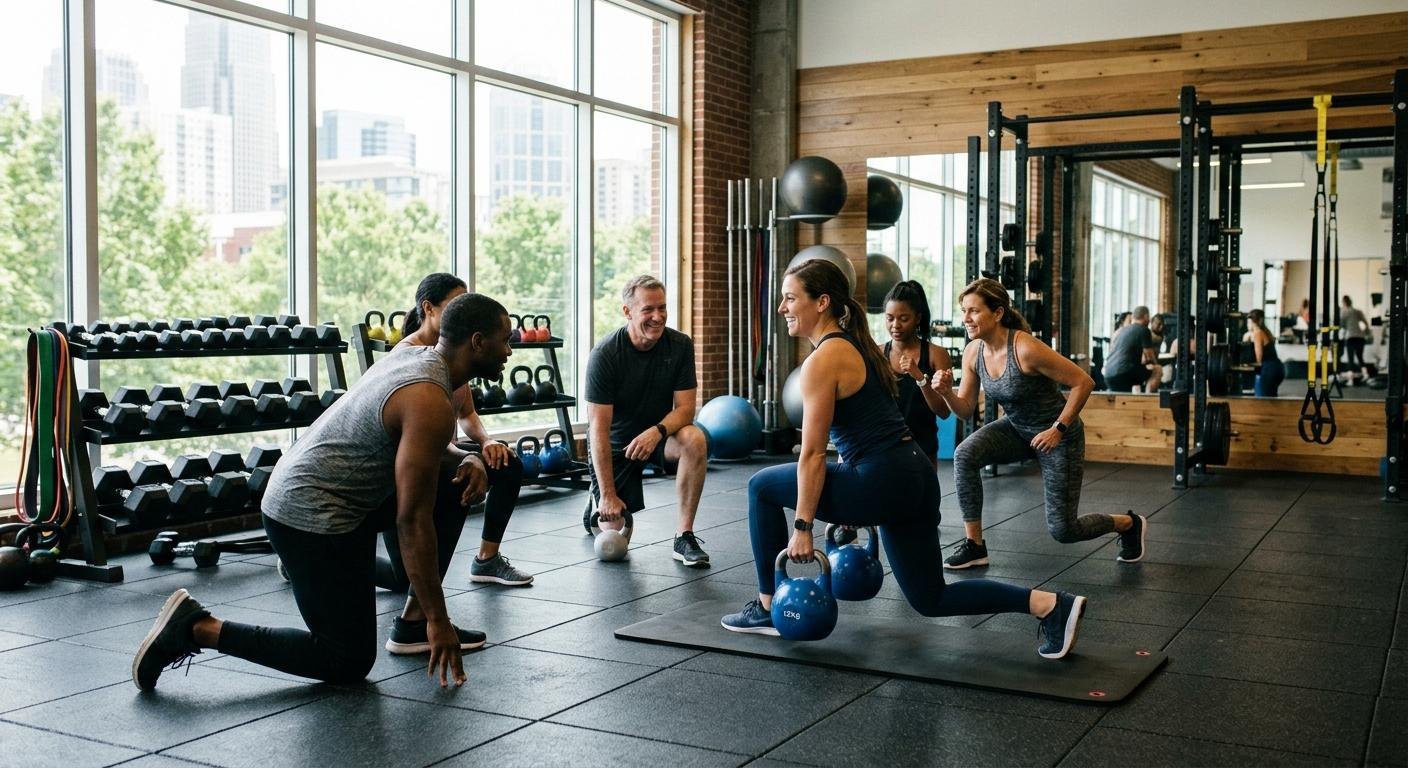

What Is Small Group Training?
Small group training is a fitness format in which a trainer works with a limited number of participants during the same session. Unlike a large group exercise class, small group sessions often provide more opportunities for individual feedback, exercise adjustments, and personalized coaching.
Participants may follow a shared workout while working toward different goals. For example, one person might focus on building strength, another might want to improve balance, and someone else might be returning to exercise after a long break. A knowledgeable trainer can help each participant choose appropriate exercises and modifications.
This format combines the benefits of professional guidance with the encouragement that comes from exercising alongside other people. Instead of navigating every workout alone, participants have a coach who helps them understand proper technique, track progress, and work through challenges.
What Makes Traditional Gyms Different?
Traditional gyms typically provide access to a broad selection of fitness equipment, including treadmills, stationary bikes, free weights, resistance machines, and functional training areas. Depending on the facility, members may also have access to group exercise classes, personal training, swimming pools, or other amenities.
The biggest advantage is flexibility. Members can generally arrive at their preferred time, select their own exercises, and determine how long they want to train. This independence can work well for people who already understand exercise programming and feel comfortable adjusting their routines.
However, a traditional gym may require more self-direction. Beginners might not know which exercises to perform, how much weight to use, or how to organize a balanced workout. During busy periods, equipment may be occupied, and the gym environment can sometimes feel overwhelming.
Traditional gyms are not inherently less effective than small group programs. The results depend on workout quality, consistency, recovery, and whether the training approach matches the individual’s needs.
Personal Attention and Professional Coaching
One of the most important differences between these fitness options is the level of coaching available during a workout.
In a traditional gym, members who exercise independently are responsible for choosing their routines, monitoring their technique, and deciding when to increase resistance or change exercises. Some facilities offer personal training, but these sessions typically involve an additional fee.
Small group training includes coaching as part of the session. Trainers can demonstrate exercises, explain movement patterns, correct technique, and suggest modifications when needed. Participants also have an opportunity to ask questions and receive feedback throughout the workout.
For beginners, this guidance can make exercise less intimidating. Someone learning to perform squats, lunges, rows, or pressing movements may benefit from having a coach explain the movements and help identify an appropriate starting point.
Experienced exercisers can also benefit from coaching. A trainer may introduce new progressions, identify areas for improvement, and help prevent workouts from becoming repetitive.
When researching small group personal training Charlotte options, ask how many participants typically attend each session and how the trainer provides individual feedback. Group size alone does not guarantee a personalized experience, so the coaching approach matters just as much.
Motivation, Accountability, and Consistency
Starting a fitness routine is one challenge. Maintaining it for months or years is often more difficult.
Traditional gyms give members the freedom to exercise whenever they want, but that freedom can make it easier to skip workouts when motivation drops. Without a scheduled class or trainer expecting them to attend, some people struggle to maintain a consistent routine.
Small group training introduces a greater sense of accountability. Sessions are scheduled, workouts have a clear purpose, and participants become familiar with the trainer and other members. Knowing that others will be there can provide an extra reason to show up.
The social atmosphere can also make exercise more enjoyable. Participants can celebrate progress, encourage each other during challenging workouts, and develop a sense of belonging.
Small groups offer structure without crowds.. This balance can appeal to people who want the support of a fitness community without the noise, size, or intensity of a packed group class.
Motivation is not identical for everyone. Some people thrive on social interaction, while others prefer quiet, independent workouts. The best environment is the one that encourages you to return regularly and work toward realistic goals.
Comparing Costs and Overall Value
Cost is another important factor when deciding between small group training and a traditional gym membership.
Traditional gyms often offer lower monthly membership prices, especially when members choose basic access without additional services. This can be a suitable option for people who enjoy exercising independently and already know how to structure their workouts.
Small group training usually costs more than basic gym access because the program includes coaching, workout planning, and a more organized training experience. However, it often costs less per session than working one-on-one with a personal trainer.
When comparing prices, consider more than the monthly fee. Think about how often you will attend, whether you need help developing a workout plan, and how much value you place on coaching and accountability.
For example, a low-cost gym membership may not provide much value if you rarely attend or spend your workouts unsure of what to do. A more structured program could be a better investment if it helps you establish a routine and use your exercise time more effectively.
Before committing, ask about session frequency, membership terms, cancellation policies, assessment sessions, and any additional charges. A trial session can help you determine whether the coaching and atmosphere justify the cost.
Which Option Is Better for Beginners?
People who are new to exercise often benefit from a supportive environment that makes the process easier to understand.
In a traditional gym, beginners may need to learn how to use equipment, select appropriate weights, and organize exercises into a balanced routine. Some people enjoy learning independently, while others feel uncertain about where to start.
Small group training can provide a clearer starting point. A trainer can explain the purpose of each movement, demonstrate proper technique, and offer easier or more challenging variations based on individual ability.
This guidance may be especially helpful for people returning to exercise after a long break. Rather than attempting an advanced workout immediately, participants can build a foundation through manageable exercises and gradually increase difficulty.
Beginners should still ask about the trainer’s qualifications, experience working with different fitness levels, and approach to adapting exercises. A good coach recognizes that participants have different abilities and does not expect everyone to perform every movement in exactly the same way.
Workout Variety and Progress Tracking
A well-designed fitness program should evolve as your strength, endurance, and confidence improve.
Traditional gyms offer a wide variety of equipment, allowing members to experiment with different training methods. People who enjoy researching workouts and planning their own routines may appreciate this flexibility.
The challenge is knowing when to change exercises, increase resistance, or adjust training volume. Without a clear plan, some members repeat familiar workouts without making meaningful progress, while others change routines too frequently to measure improvement.
Small group training often follows a planned progression. Trainers may monitor exercise performance, adjust resistance, introduce more challenging variations, and help participants recognize improvements over time.
Progress can include more than lifting heavier weights. Better balance, improved movement control, increased stamina, greater confidence, and the ability to complete daily activities with less effort are also meaningful outcomes.
When evaluating small group personal training Charlotte programs, ask how progress is measured and whether the trainer reviews individual goals. A program that tracks results can help you understand what is working and where adjustments may be needed.
Scheduling and Convenience for Charlotte Residents
Convenience plays a major role in whether a workout routine becomes a lasting habit. Even a well-designed program can be difficult to maintain if getting to the gym requires too much time or conflicts with work and family responsibilities.
Traditional gyms generally offer greater freedom to choose workout times. Members can often exercise early in the morning, during lunch breaks, or later in the evening, depending on facility hours.
Small group training usually operates on a set schedule. This can be helpful for people who prefer appointments and routine, but it may be less convenient for anyone with unpredictable working hours.
Charlotte residents should consider commute times, parking, session availability, and the distance between the facility and home or work. A convenient location can make it easier to attend consistently.
Before enrolling, review the schedule and determine whether the available sessions fit your typical week. Ask whether makeup sessions are permitted if you miss a workout and whether booking ahead is required.
Building Strength, Improving Fitness, and Supporting Healthy Aging
Both small group training and traditional gyms can support important health and fitness goals when used consistently and appropriately.
Strength training helps develop muscular strength and supports everyday activities such as carrying groceries, climbing stairs, and getting up from a chair. Cardiovascular exercise supports heart health and endurance, while balance and mobility exercises can help improve movement confidence.
Small group programs may be especially useful for people who want guidance across several areas of fitness. A trainer can help organize sessions that include resistance exercises, conditioning, balance work, and mobility activities according to each participant’s ability and goals.
Traditional gyms can provide the same opportunities, particularly for members who understand how to create a balanced exercise routine or work with a personal trainer.
Adults who are interested in healthy aging may appreciate a program that emphasizes proper technique, gradual progression, recovery, and functional movement. People with injuries, persistent pain, or medical conditions should consult an appropriate healthcare professional before beginning a new exercise program and should inform their trainer about relevant limitations.
The goal is not to choose the most intense workout. It is to find an appropriate training approach that can be sustained safely over time.
How to Choose the Right Fitness Option
Before choosing between a traditional gym and small group training, take a moment to identify what you need most from your fitness routine.
Consider the following questions:
- Do you feel confident planning and completing workouts independently?
- Would you benefit from a trainer demonstrating exercises and correcting your technique?
- Are you more likely to attend when you have a scheduled appointment?
- Do you enjoy exercising with other people?
- Is your priority access to a wide range of equipment, or do you prefer a guided program?
- Does your budget allow for coaching, and how much value would that support provide?
- Can you consistently attend sessions at the available times?
If independence, flexible hours, and access to equipment are your priorities, a traditional gym may be the right fit. If you want professional guidance, a planned workout, and a supportive community, small group training may be more suitable.
You should also visit the facility if possible. Observe how the trainer interacts with participants, whether the space feels comfortable, and whether the workout seems adaptable to different ability levels. Ask about the program’s approach to beginners, progress tracking, and individual modifications.
The best choice is not necessarily the most expensive or popular option. It is the one that fits your lifestyle and helps you exercise consistently.
Final Thoughts
Small group training and traditional gyms both offer valuable ways to improve fitness, but they serve different preferences. Traditional gyms provide independence, equipment variety, and scheduling flexibility. Small group programs add coaching, structure, accountability, and opportunities to connect with other people pursuing similar goals.
For people who find it difficult to stay motivated alone or who want help learning proper exercise technique, small group training can offer a useful balance between personal attention and community support.
When exploring small group personal training Charlotte options, look beyond the price and class size. Consider the trainer’s experience, the quality of instruction, the program’s flexibility, and how progress is measured. Choosing a setting that supports your needs can make fitness feel more manageable and help you build habits that last.
Frequently Asked Questions
Is small group training better than a traditional gym?
Neither option is universally better. Small group training provides coaching, structure, and accountability, while traditional gyms offer independence, equipment variety, and flexible workout times. The best choice depends on your goals, experience, budget, and preferences.
How many people participate in small group training?
Group sizes vary by facility and program. Some sessions have only a few participants, while others accommodate larger groups. Ask about the typical group size and how much individual feedback each participant receives before enrolling.
Is small group personal training suitable for beginners?
Yes. Small group training can be a good starting point for beginners because trainers can demonstrate movements, explain exercise technique, and offer modifications. Participants should choose a program that accommodates different fitness levels and progresses gradually.
Does small group training cost more than a gym membership?
Small group training generally costs more than basic gym access because coaching and structured workouts are included. However, it can be less expensive per session than one-on-one personal training. Compare the total cost with the guidance and support provided.
Can I build muscle with small group training?
Yes. A well-designed small group program can help build muscle through progressive resistance training, appropriate recovery, and consistent participation. Results depend on factors such as training quality, nutrition, sleep, and individual circumstances.
How often should I attend small group training sessions?
The appropriate frequency depends on your fitness level, goals, recovery, and overall activity. Many programs offer multiple weekly sessions, but beginners may need to start gradually. A qualified trainer can help you develop a sustainable schedule.
What should I look for in a small group training program in Charlotte?
Look for qualified trainers, manageable group sizes, clear workout plans, appropriate exercise modifications, progress tracking, convenient scheduling, and transparent pricing. A trial session can help you assess whether the environment fits your needs.
Can small group training help me stay motivated?
It can. Scheduled sessions, trainer guidance, and encouragement from other participants can make exercise more consistent and enjoyable. However, individual experiences vary, so it is important to choose a group and schedule that suit your personality and lifestyle.