
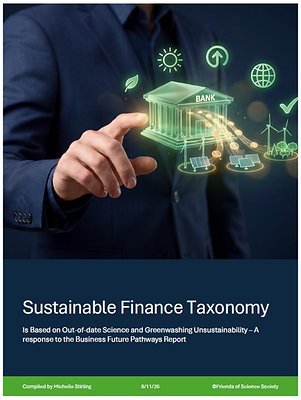

CALGARY, AB, Aug. 20, 2026 /PRNewswire/ — As talk of a potential rebirth of Keystone XL pipeline rises in Canada-US trade negotiations, a Friends of Science Society open letter urges the Office of the Superintendent of Financial Institutions (OSFI) to rethink their climate risk guideline, B-15, in order to REcarbonize Canada.
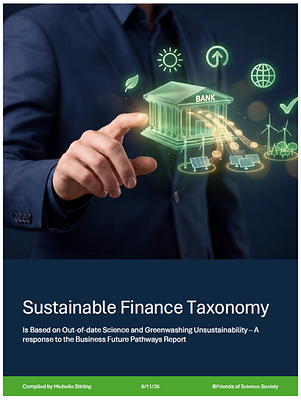
In the August 19, 2026, letter to OSFI, Friends of Science Society says the economic and scientific justifications for climate risk reporting by financial institutions, which underly Guideline B-15, are no longer valid.
The Friends of Science Society letter was written before the surprise Keystone XL comment by President Trump in a Truth Social post.
Canada’s Business Futures Pathways group is in the process of defining a green taxonomy. In their letter to OSFI, Friends of Science Society references a new report critiquing the taxonomy group, titled, “Sustainable Finance Taxonomy: Out-of-date Science and Unsustainable Greenwashing.” The taxonomy is based on the out-dated science of the Intergovernmental Panel on Climate Change (IPCC) Special Report 1.5 of 2018. Much of that SR 1.5 report was predicated on the climate catastrophe scenario known as RCP 8.5 (SSP5-8.5). RCP 8.5 has been sidelined as “implausible” by the official climate modelling group of the IPCC. OSFI’s climate risk guidelines are also based on this implausible scenario.
As long-time climate policy analyst, Roger Pielke, Jr., explains, “No, RCP8.5 Did Not Become Implausible Because of Climate Policy“, it was not the Paris Agreement, climate policies nor the declining cost of renewables that made RCP 8.5 implausible; it was always implausible.
Friends of Science Society argues that the recent dramatic shifts in global geopolitics and energy shocks are not reflected in the Sustainable Finance Taxonomy report, nor in OSFI’s Guideline B-15. It was finalized in February of 2025 to align with Canadian Sustainability Standards Board 2024 guidelines, thus all three are out-of-date.
Friends of Science Society says that without the RCP 8.5 climate catastrophe scenario, the claim of a climate emergency evaporates; markets should return to normal evaluation of energy companies without climate prejudice, particularly in a time of global energy deficits due to conflicts in the Strait of Hormuz and between Ukraine and Russia.
As Dr. Tammy Nemeth writes in the Financial Post of August 20, 2026, “Canada’s new green taxonomy distorts capital markets,” the purpose of the green taxonomy is to draw Foreign Direct Investment (FDI), but over half of Canada’s FDI comes from the USA, which is abandoning all climate obsessions. The US Securities and Exchange Commission has begun a formal process of rescission of all climate-related reporting requirements.
In the letter to OSFI, Friends of Science Society references comments from the National Association of Manufacturers’ submission to the SEC consultation, on the financial burden of such reporting.
In 2022, Friends of Science Society published a post outlining the economic burden of mandatory Scope 1, 2, 3 emissions reporting, rejecting the “Integrity Matters” proposals of Catherine McKenna, and her UN High Level Expert Panel’s push for absolute GHG reductions (not just ‘net’ zero) as a risk to society – there is no material supply chain to support their ‘green’ dreams.
The Financial Times published a report on Aug. 20, 2026, titled “Donald Trump proposed reviving the Keystone XL pipeline. Does Canada still want it?” saying that “bilateral relationship has soured” since the project was first proposed. They showed an image of Tar Sands Campaign protestors but did not mention the global campaign to demarket Alberta oil, to sour domestic and international relations.
Canadian climate activists banded together with Indigenous groups to specifically block Keystone XL, as reported in the 2010, 9th Annual Report of the International Funders for Indigenous Peoples.
Friends of Science Society has written “Fear and Loathing – The Alberta Oil Sands, from national pride to international pariah,” a detailed report on the Tar Sands Campaign, issued in December 2019. Alberta bitumen is ideally suited to the Gulf Coast refineries. In a world of energy deficits, if Keystone XL is revived, it could be an energy lifeline for many countries and would jumpstart the Canadian economy.
Friends of Science Society says to REcarbonize Canada, the country must deregulate and revise OSFI’s Guideline B-15 to reflect the scientific, economic and global energy realities; only then can Canada become an energy superpower.
About
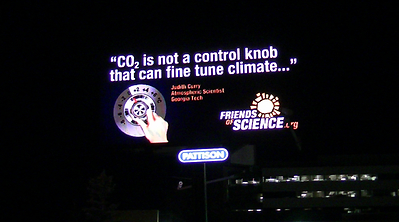
Friends of Science Society is an independent group of earth, atmospheric and solar scientists, engineers, and citizens that is celebrating its 24th year of offering climate science insights. After a thorough review of a broad spectrum of literature on climate change, Friends of Science Society has concluded that the sun is the main driver of climate change, not carbon dioxide (CO2).
Friends of Science Society
PO Box 61172 RPO Kensington
Calgary AB T2N 4S6
Canada
Toll-free Telephone: 1-888-789-9597
Web: friendsofscience.org
E-mail: contact@friendsofscience.org
Web: climatechange101.ca
 View original content to download multimedia:https://www.prnewswire.com/news-releases/canadian-banking-regulator-urged-to-rethink-climate-risk-guideline-says-friends-of-science-keystone-xl-could-recarbonize-canada-302856866.html
SOURCE Friends of Science Society

Distributed by PR Newswire / Cision.