
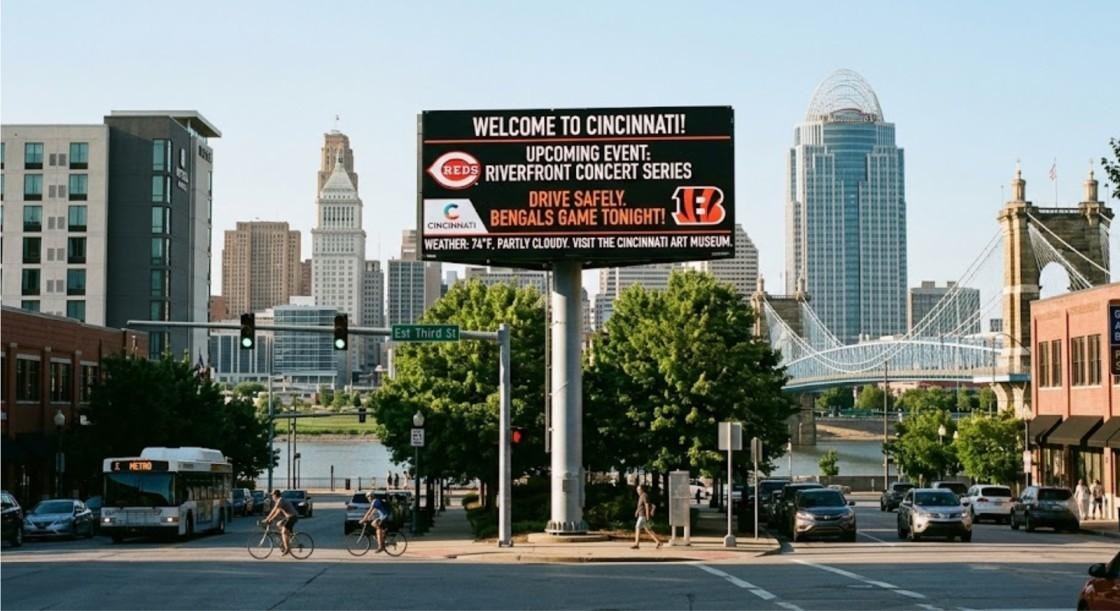

In Greater Cincinnati’s competitive commercial corridors, capturing the attention of passing drivers and pedestrians is a daily challenge for brick-and-mortar businesses. Whether your location is situated along a bustling highway in West Chester, a high-traffic intersection in Blue Ash, or a walkable shopping district in downtown Cincinnati, static signage can only communicate a single, unchanging message. When promotions change, seasons shift, or inventory expands, static letters and painted boards quickly lose their effectiveness and visual impact.
To stay relevant and drive consistent foot traffic, modern organizations are upgrading to dynamic, high-resolution digital signage. An outdoor LED display acts as a tireless, 24/7 on-site marketing engine that allows you to communicate with your community in real-time. Retailers and offices across Cincinnati turn to electronic message center prices for modern, reliable sign solutions that attract and inform. By combining architectural presence with digital flexibility, an Electronic Message Center (EMC) transforms your property’s exterior into your most lucrative advertising channel.
1. Unmatched Advertising Efficiency and Lower Cost-Per-Thousand (CPM)
When evaluating marketing investments, business owners must analyze the Cost Per Thousand Impressions (CPM) the metric that calculates how much it costs to reach one thousand potential customers. Traditional advertising mediums such as radio, local television, print media, and off-site billboards require recurring monthly expenditures that rarely guarantee a lasting return on investment.
An on-site electronic message center drastically outperforms traditional media in cost efficiency. Once the physical display is fabricated and installed on your property, your ongoing advertising cost drops to fractions of a penny per thousand impressions. Your display leverages the existing vehicular and pedestrian traffic passing your building every day. Instead of renting space on a billboard miles away from your storefront, you own a high-impact advertising medium situated directly at your point of sale, capturing high-intent commuters when they are just steps away from your entrance.
2. Real-Time Marketing Agility and Cloud-Based Control
The primary advantage of choosing an electronic message center is operational agility. In the past, updating an exterior sign required physically climbing a ladder in freezing winter weather to swap out acrylic reader-board letters, or waiting weeks and paying hundreds of dollars for a print shop to produce new vinyl banners.
Modern EMC systems eliminate these logistical hurdles entirely through cloud-based content management software.
- Instant Updates: Marketing teams can log into a secure dashboard from any smartphone, tablet, or desktop computer to push new campaigns instantly.
- Dayparting and Scheduling: You can schedule advertisements based on specific times of day or days of the week. A restaurant can automatically display hot breakfast specials during the morning commute, lunch promotions at noon, and family dinner packages during the evening rush.
- Responsive Trigger Messaging: Advanced systems allow you to tie your displays to real-time data feeds, displaying automatic promotions triggered by local weather shifts, community sports victories, or flash inventory clearances.
[ Cloud Content Management System ]
               │
               ▼
   [ Secure Wireless / Cellular Data Link ]
               │
               ▼
[ On-Site Electronic Message Center Display ]
               │
               ├──> Morning Commute: Breakfast & Coffee Specials
               ├──> Afternoon: Flash Retail Sales & Services
               └──> Evening / Weekend: Community Events & Branding
3. Demystifying Pixel Pitch and Visual Resolution
Understanding visual resolution is critical when evaluating an electronic message center for your property. The clarity of an LED sign is governed by its pixel pitch, the precise measurement in millimeters between the center of one LED cluster and the center of the adjacent cluster.
Selecting the correct pixel pitch depends heavily on the speed of passing traffic and the physical distance between your sign and your audience:
- Tight Pixel Pitch (6mm to 10mm): Ideal for monument signs, pedestrian plazas, and storefronts where viewers are close to the display or stopped at a traffic light. These screens produce smooth, photorealistic graphics and crisp video reproduction without pixelation.
- Wide Pixel Pitch (16mm to 19mm): Engineered for towering highway pylon signs viewed from hundreds of feet away by vehicles traveling at high speeds. At long distances, the human eye naturally blends the wider LED clusters together, delivering brilliant readability at a more cost-effective hardware price point.
4. Engineering for the Ohio Valley Climate
Operating an electronic display outdoors in Southwest Ohio requires robust hardware engineering. Commercial signs in this region must withstand intense summer ultraviolet (UV) radiation, torrential spring rain, high humidity, and severe winter freeze-thaw cycles. Low-cost, imported display cabinets frequently fail when exposed to these environmental extremes, resulting in dead pixel clusters, internal moisture condensation, and premature power supply burnouts.
High-quality commercial EMCs are built with solid-state, fully encapsulated LED modules that seal out moisture and dust. Modern displays utilize advanced extruded aluminum cabinets with passive cooling designs that eliminate the need for mechanical intake fans. By removing moving internal cooling parts, industrial-grade LED signs prevent water and debris ingress, ensuring reliable performance and uniform brightness even during harsh winter blizzards or 95-degree summer heatwaves.
Technical Comparison: Static Exterior Signage vs. Modern EMCs
| Performance Factor | Traditional Static Signage | Modern Electronic Message Centers |
| Content Flexibility | Single, permanent message; costly and time-consuming to alter. | Unlimited digital campaigns; instant updates via cloud software. |
| Visual Impact | Reliant on external floodlights at night; blends into background over time. | High-nit, self-illuminating LED brightness that commands attention 24/7. |
| Audience Engagement | Passive viewing; cannot adapt to viewer time of day or weather. | Dynamic full-motion graphics, dayparting scheduling, and real-time alerts. |
| Long-Term Marketing ROI | Fixed utility; requires ongoing supplemental advertising spend. | Lowest CPM in local advertising; drives measurable impulse foot traffic. |
5. Maximizing Your Return on Investment (ROI)
While investing in a custom electronic message center involves a higher initial capital outlay than erecting a standard non-illuminated sign, the financial returns are measurable and rapid. By significantly increasing curb appeal and broadcasting dynamic sales messages to passing traffic, businesses regularly experience a 15% to 50% increase in overall sales volume following an EMC installation.
Furthermore, modern LED technology is exceptionally energy efficient. Solid-state diodes consume a fraction of the electricity required by legacy fluorescent or neon lighting systems while delivering significantly higher lumen output. When paired with automated photocell sensors that dynamically adjust screen brightness based on ambient sunlight dimming automatically at night and brightening during sunny afternoons your operating utility costs remain low while your visual impact stays at peak performance.
Conclusion
Your physical storefront is the foundation of your local brand identity, and your exterior signage serves as your primary introduction to the community. Relying on static, unchangeable displays limits your ability to compete in a fast-paced retail landscape. By investing in a high-resolution electronic message center, you take control of your local marketing, reduce recurring advertising expenditures, and create an engaging, modern beacon that drives sustained foot traffic to your door for years to come.
Frequently Asked Questions (FAQ)
Q: Do I need a special municipal permit to install an electronic message center in Greater Cincinnati?
A: Yes. Most municipalities across Greater Cincinnati, including local township zoning boards, have specific ordinances governing electronic message centers. These rules typically regulate maximum screen brightness (nit levels), allowable square footage, minimum hold times between message transitions, and animation styles. A full-service commercial sign company will handle the entire engineering, zoning review, and permit acquisition process on your behalf to ensure 100% legal compliance.
Q: How difficult is it to train my staff to use the sign programming software?
A: Modern cloud-based EMC software is designed with user-friendly, intuitive interfaces similar to basic graphic design apps or social media scheduling tools. Most systems feature drag-and-drop template libraries, pre-built holiday animations, and automatic text sizing. Professional sign providers typically include comprehensive staff training and ongoing technical support upon installation.
Q: What is the expected lifespan of a commercial-grade outdoor LED sign?
A: When fabricated with premium, weather-sealed LED modules and proper solid-state power supplies, a commercial electronic message center is typically rated for 100,000 hours of continuous operation. This translates to roughly 11 to 13 years of reliable 24/7 performance before any significant lumen degradation occurs.